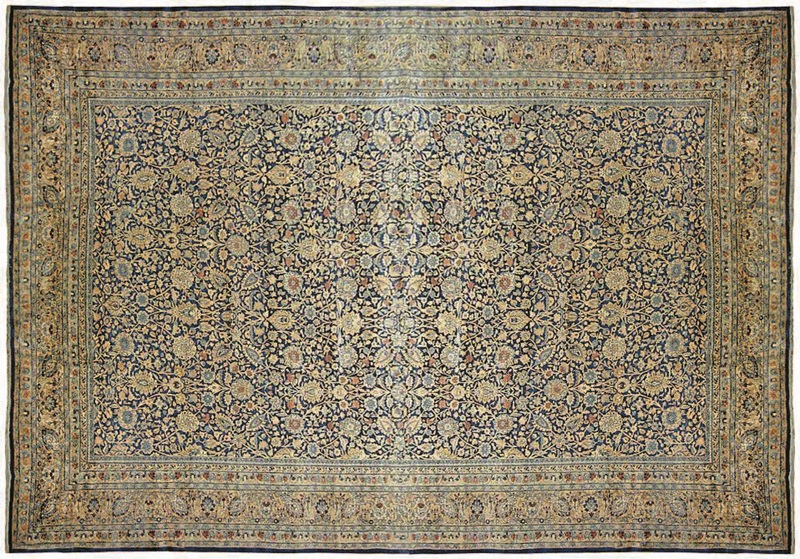
In recent issues of Rug Insider Magazine, we have focused on a number of antique Persian carpet styles, with most of those types of rugs emanating from Iran’s Northwest, such as Tabriz and Sultanabad rugs, from Iran’s central regions, such as Kashan rugs, and from Iran’s South, such as Kerman rugs. A significant style that we will be exploring here are from Iran’s Northeast, from the province of Khorason, and more specifically, from its capital city of Meshed.
LOCATION AND HISTORY
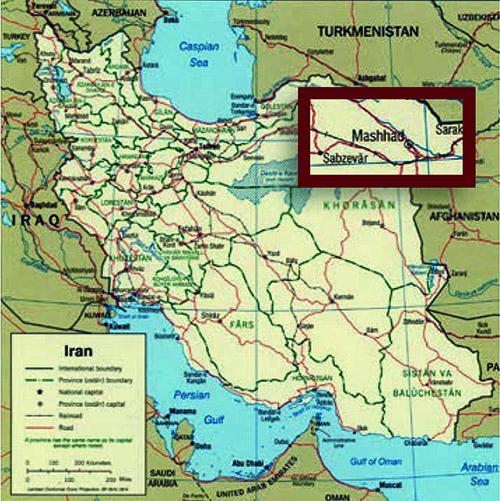
The Khorason province in Persia’s Northeast borders the Salt Desert to the West, and Turkmenistan and Afghanistan to the East. It has been a weaving center for traditional carpets for centuries, and can be traced back to 16th century or even earlier, when it was one of the key stops and an oasis on the Silk Road, which was an ancient trade route between China, the Middle East, India, and beyond. Different types of precious merchandise, including Persian rugs, were traded on this Silk Road, which connected merchants from the North to the South, and the East to the West. Beyond its importance to international trade, the Khorason province, and specifically the city of Meshed (also Mashhad), were well very traveled within the Islamic world, with millions of Muslims visiting each year as part of their annual pilgrimage to memorialize the Eighth Imam’s burial site. Between traveling merchants traversing the Silk Road, millions of people making their annual pilgrimage, and a resident population of over three million people, Meshed is a hugely important city, and is Iran’s second largest. This enormous city is renowned for many things, one of the chief of which is its eponymous style of finely woven Persian carpets.
STYLE AND CONSTRUCTION
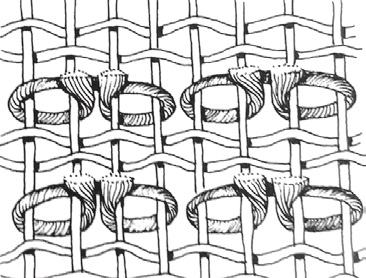
Meshed and Khorason rugs are similar in style, appearance, and construction, and typically feature intricate floral designs with rich colors, with a fine weave. Both styles are known to be “jufti” knotted, with wool pile on a cotton foundation. The name “jufti” refers to a pair, and in this case, the pair in question refers to the knots being tied across four warp threads, as opposed to being tied to two warp threads, which is more commonly found in other rug styles.
These “jufti” knots are tied onto a cot-ton foundation that features depressed warp threads (up and down cords), with the weft threads (side to side cords) pulled very tightly to create a high degree of tension. The weft cords are doubled up and stretched from side to side, creating a unique visual effect, greater stability and durability, and making this style of rug one of the most long lasting and resistant to wear within the wide world of Persian rugs.
KHORASON VS. MESHED RUGS
Given that Meshed is a city within the larger province of Khorason, and that their rugs largely feature the same type of weave and construction, what then are the differences between Khorason and Meshed rugs?
Depending on who you ask, it could be some minor variations in the weave between the one style and the other, that the colors are not as deep or saturated in the one versus the other, or that rugs that are from 1900 and before are referred to as Khorason, whereas the rugs woven from the turn of the 20th century and after that are classified as Meshed.
Another difference is that Khorason, being a very large province, incorporates stylistic elements and aesthetic influences from the neighboring Turkoman, Kurdish, and Afghani regions. This manifests itself in the Khorason rugs having a slightly less curvilinear floral design and more of a village rug feel than the Meshed city rugs do, and having more florogeometric elements and a more spaced out layout as part of their design.
KHORASON DOROKHSH RUGS
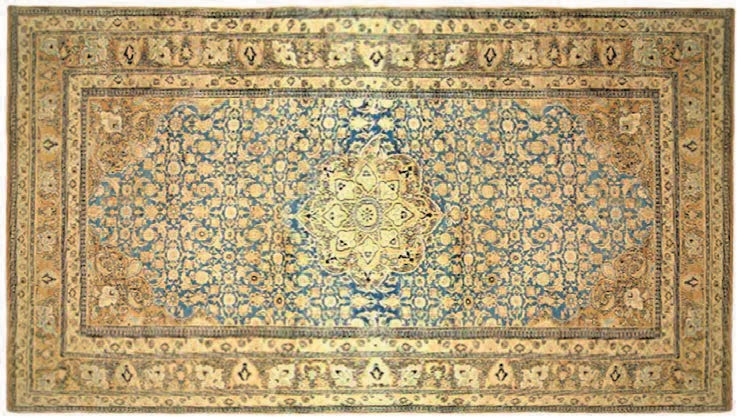
Another sub-division of the Khorason rug family is the Khorason Dorokhsh rug, which emanates from the Dorokhsh Hills in the Khorason province.
The Dorokhsh rug style has a simpler knotting technique than the Khorason and Meshed rugs do, resulting in rugs that are not quite as dense, and that make for finer articulation of specific designs.
These specific designs often lend themselves to such motifs as leaves, birds, paisleys, or in some cases, vase designs, with majestic floral sprays emanating from an elaborate vase at one end, and winding its way through-out the central field, as in the rug pictured above.
THE VINTAGE MESHED
Having explored the older, more floro-geometric Khorason rug, and its thinner, more stylized variant, the Dorokhsh rug, let us now consider the Persian Meshed rug.
When we discuss the Persian Meshed rug, the first thing that might come to mind for many people in the rug trade might not be the antique Persian Meshed rug, which we will examine next, but rather the vintage Persian Meshed, which proliferated in Europe and the United States in the mid 1900’s.
There was a boom in the export of various styles of Persian rugs to the West, including Europe and the Americas, from the second quarter of the 20th century and afterward, which encompassed a wide variety of carpet styles, including such rugs as Kerman, Sarouk, Tabriz, and Meshed. As such, the vintage Persian Meshed rugs of this era have become one of the types that Western buyers are most familiar with.
These vintage Persian Meshed rugs have an extra thick wool pile, very dense construction, rich, deeply saturated colors, and a stylish foliate design, usually coordinated around a central medallion and its corner spandrels.
After the antique Bidjar, these vintage Meshed rugs can stand neck and neck with the Persian Sarouk and some other such styles as some of the sturdiest and most durable of Persian rugs, with great endurance and resistance to wear.
These vintage Mesheds are not only sturdy and durable, with rich, deep colors and classic designs, but they are also a great value, relatively speaking, and are often sought out by cur-rent day rug buyers who want to find a great traditional rug, but at supremely affordable prices.
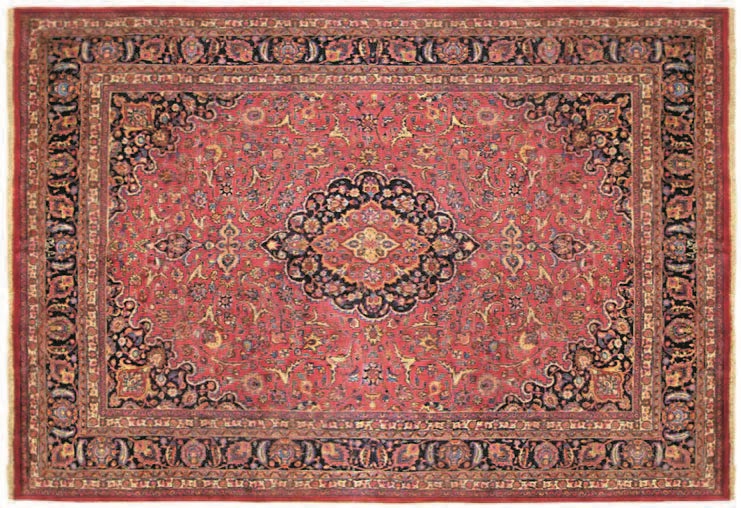
THE ANTIQUE MESHED
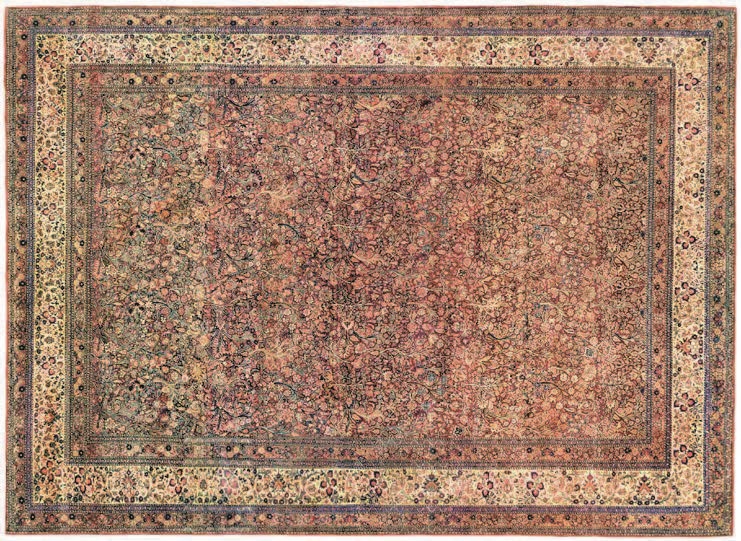
While the vintage mid-century Persian Meshed rug might be more commonly found or be better known to Western rug buyers, it is the antique Meshed rugs from the first quarter of the 20th century that display some of the finest weaves and artistry of the rugs from this Northeastern Persian city.
The antique Persian Meshed can compete with some of the finest Persian rugs, including Northwestern rugs like the Tabriz and the Sarouk, central Persian rugs like the Kashan, and Southern Persian rugs like the Kerman, for how dazzling and complex their designs can be, and how finely articulated are their floral renderings.
These antique Meshed carpets could exhibit the incredible dexterity of their weavers, both in terms of how much design they could execute and fit into the rug in outrageously small scale, as with the rug displayed at left, or in some cases, how they could take a well known, standard design motif and add new layers of beauty and complexity to it, as with the rug displayed on the following page.
In this antique Meshed carpet, the weavers have taken a traditional paisley design, which is a motif commonly found in many different types of Persian rugs. The twist they have added is to embed a miniature paisley design within each larger paisley element, making for a rare and highly treasured “mother and child paisley” motif, wherein each paisley is like a mother, swaddling its own paisley child within itself.
The effect is both aesthetically out-standing, and deeply meaningful to the Persian populace, for whom this “mother and child” motif carries a great deal of cultural significance, meaning, and understanding, and makes the rug an ideal choice for use to celebrate weddings or the birth of a child.
THE AMOGHLI AND SABER MESHEDS
In reviewing the different types of vintage and antique Persian Meshed carpets, no discussion would be complete without referencing some of the great master weavers from that region whose names are synonymous with Meshed rugs.
One of the top weavers from Meshed, whose workshop turned out some of the region’s finest antique rugs in the first quarter of the 20th century, was Amoghli. An “Amoghli Meshed” rug was the finest of the fine, displaying not only the beautiful artistry, symmetry, and articulation of design that only a master weaver could produce, but also a higher grade of wool, which was softer, more lanolin-rich, and more lustrous than the other Meshed rugs being produced elsewhere in the city.
Like any great master, Amoghli had his students and disciples. Of those, perhaps the one that not only matched but possibly exceeded his master in the fineness of the carpets he produced in his own rug weaving workshop was Saber, who, in the second quarter of the 20th century, became the new standard bearer for what the best of the best Meshed rugs could be.
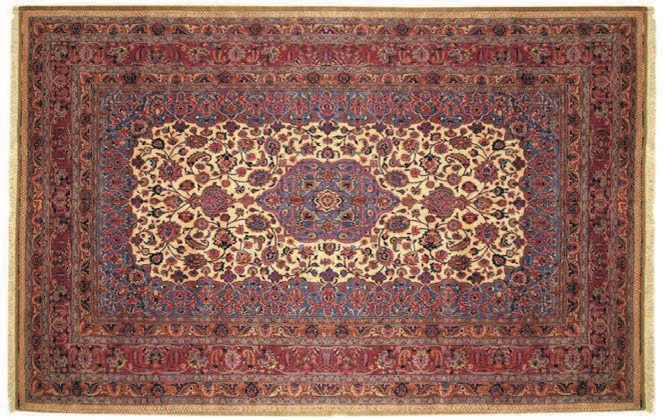
These “Saber Meshed” rugs took the ultra-fine, lanolin-rich, lustrous wool rugs of Saber’s teacher, Amoghli, and raised the bar even higher, making the weave even finer than fine, incorporating silk inlay to highlight the wool and the fine floral renderings, and adding his distinctive signature to the rugs, as great artists do.
Regardless of which style of vintage and antique Persian Meshed and Khorason rugs one might come across, these rugs carry with them a great and storied tradition, and are some of the most highly prized and sought after rugs not only from Iran’s Northeast, but throughout the wide world of hand-knotted Persian carpets! We’ll be back with more rug explorations in the next issue!
All of the antique rug styles enumerated in this article are still popular in the United States, Europe, and beyond, and the world’s finest selection of these carpets can be found in a variety of sizes, styles, and price points at Persian Gallery New York’s user-friendly website, www.pgny.com!