

Anyone who’s played the rug game long enough eventually has a “moment.” It’s that split second where the dopamine of the hunt overrides the logic of the trade. You’re looking at a piece that looked like a masterpiece in the low-res glow of a smartphone screen, but the second it’s unrolled in the cold, unforgiving light of the shop, it starts telling a very different story.
This is one of those moments. But this isn’t just a postmortem on a flip gone sideways. It’s a case study in The Great Reskilling of an industry and a lesson in how to capture the only currency that matters in 2026: Narrative.
The Buy: Euphoria vs. Reality
A few months ago, I was doom scrolling through Facebook Marketplace: a digital bazaar that is 90% landfill fodder and10% pure, unadulterated gold. Then, I saw it: a vintage Chinese Nichols.
The seller called it a 1940s piece. Roughly 9 × 12 the “Goldilocks” size of the rug world. The photos showed a soft, gray-plum field and a magenta border with scattered floral motifs that felt less like Grandma’s parlor and more like a moody, mid-century dream. It had that quiet, understated elegance that Nichols pieces are known for.
-
The Ask: $800.
-
The Close: $500.
Even through a cracked iPhone screen, it looked like the kind of piece that could anchor a $10M Tribeca loft. Nichols rugs have always had that crossover appeal; they’re the “gateway drug” for modernists who think they hate traditional carpets. They carry the weight of history without the stuffy baggage.
I knew it would need work. Vintage rugs always do. But I was blinded by the “deal.” (LIGHT THE ROARING SILENCE)
The Rookie Mistake
Here is the Scott Galloway-style “Algebra of Failure”: Speed+ Overconfidence = Margin Erosion.
I met the seller. In the rush, I handed over the cash before doing a thorough four corner inspection. Anyone in the trade knows better. It’s the cardinal sin. But sometimes the adrenaline of the acquisition gets ahead of the discipline of the process.
We got it back to the shop, rolled it out under the high-RESLEDs, and the reality revealed itself like a hangover at noon.
- Foundation Knot Heads: The rug was riddled with them. Years of wear had allowed the internal structure to push through the surface. From ten feet away, it was a Monet. From two feet away, it was a topographical map of neglect.
- The Stains: Shadows that looked like “patina” in the photos turned out to be deep, mysterious biological insults.
I had to ask: Did I just incinerate five hundred bucks?
The Pivot: From Commodity to Content
For a pure flipper, this rug was a disaster. The wear meant it would never be “pristine,” and the labor-to-margin ratio was trending toward zero. But if you stop looking at the rug as a product and start looking at it as an experience, the math changes.
We live in an era where the most valuable thing you canown is a soul. The younger generation, the cohorts currentlyinheriting trillions in the Great Wealth Transfer don’t want asterile, machine-made slab of polypropylene from a big-boxretailer. They want the story.
Look at social media. People are mesmerized by restoration.Why? Because watching an object move from “neglected”to “vibrant” provides a psychological hit of order in achaotic world. Yet, the rug industry, an industry built onthousand-year-old artisanal traditions is failing to tell thatstory. Most shops hide the “ugly” parts. They treat the washprocess like a shameful secret.
That is a strategic blunder.
The Execution: The Honest Wash
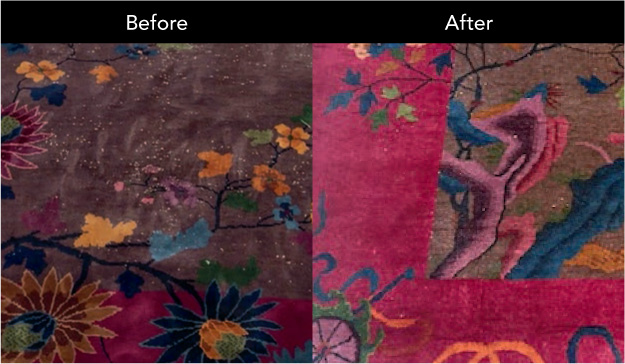
Instead of quietly washing this Nichols and hiding the flaws,we documented the carnage. We shot the knot heads. Wezoomed in on the stains. We showed the dull, gray-plumfield looking like it had spent a decade in a basement.Then, we went to work.
A proper immersion wash isn’t just “cleaning”; it’s a chemical and mechanical resurrection. We flushed out decades ofembedded soil. The magenta border started to scream again.The wool softened. Even with the wear the “honest” imperfections the rug transformed from a “questionable purchase” into a “charming vintage rescue.”
The Macro Opportunity
There is a massive, underserved market of “Thrifting Pioneers.” These are people who spend their Saturdays at estate sales and flea markets. They love the hunt, but they are terrified of the “gross factor.” They see a dusty masterpiece and walk away because they don’t know what’s possible.
As retailers, we have a choice in how we position ourselves:
- The Old Guard: Sits in a showroom of $20,000 museum pieces, complaining that “nobody appreciates real rugs anymore” while watching the foot traffic die.
- The New Guard: Becomes the “Floor Art Preservationist.”We meet the customer where they are at: the estate sale,the thrift shop, the hand-me-down, and their social media.
When you help a customer restore a vintage find, you aren’t just cleaning wool; you’re saving a piece of history from a landfill. You become the hero who validated their taste. And more importantly, you open the door to the rest of your gallery.
By showing them what a 1940s Nichols could be, you earn the trust to show them what a brand-new, hand-knotted masterpiece is. Restoration is the bridge. It reminds the masses that while a rescued vintage piece is soulful, the art of the rug is a living, breathing tradition that they can still buy fresh from the loom today.
The Bottom Line
You don’t even need to be the one scrubbing the wool. Most retailers don’t have the facility for a deep immersion wash, and that’s fine. Your job is curation and connection.
When a piece needs professional-grade salvation, you send it to a dedicated facility like RugSpa®. We handle the technical restoration, the washing, the fringe, the structural CPR. You get the credit. You become the face of the transformation.
Looking back at that $500 Nichols rug, I’m glad I made the mistake. Every dealer has a story about the one they wish they’d left behind. In this case, I bought more work than I wanted, but I ended up with a powerful reminder:
In the modern economy, perfection is a commodity. Character is a luxury. And the best way to sell a new rug is to prove you know how to love an old one.
Beau C. Burdett is the CEO of Kirishian Rugs & RugSpa® in Spokane, Washington. As the steward of a brand with over a century of local legacy, Beau balances the grit of a logistics expert with the soul of a curator, specializing in the preservation of hand-knotted “Art for the Floor.”
Alongside a team commanding over 50 years of combined expertise in rug identification, immersion washing, and structural repair, Beau is on a mission to bridge the gap between old-world craftsmanship and the next generation of collectors. Whether he’s navigating the high-stakes “hunt” of the trade or consulting with retailers to scale their own service offerings, his focus remains the same: ensuring that rugs meant to last generations actually do.
When he isn’t knee-deep in the “rug rescue” business, he’s a family man, a student of classic cinema, and a relentless pursuer of the perfect backgammon game.